
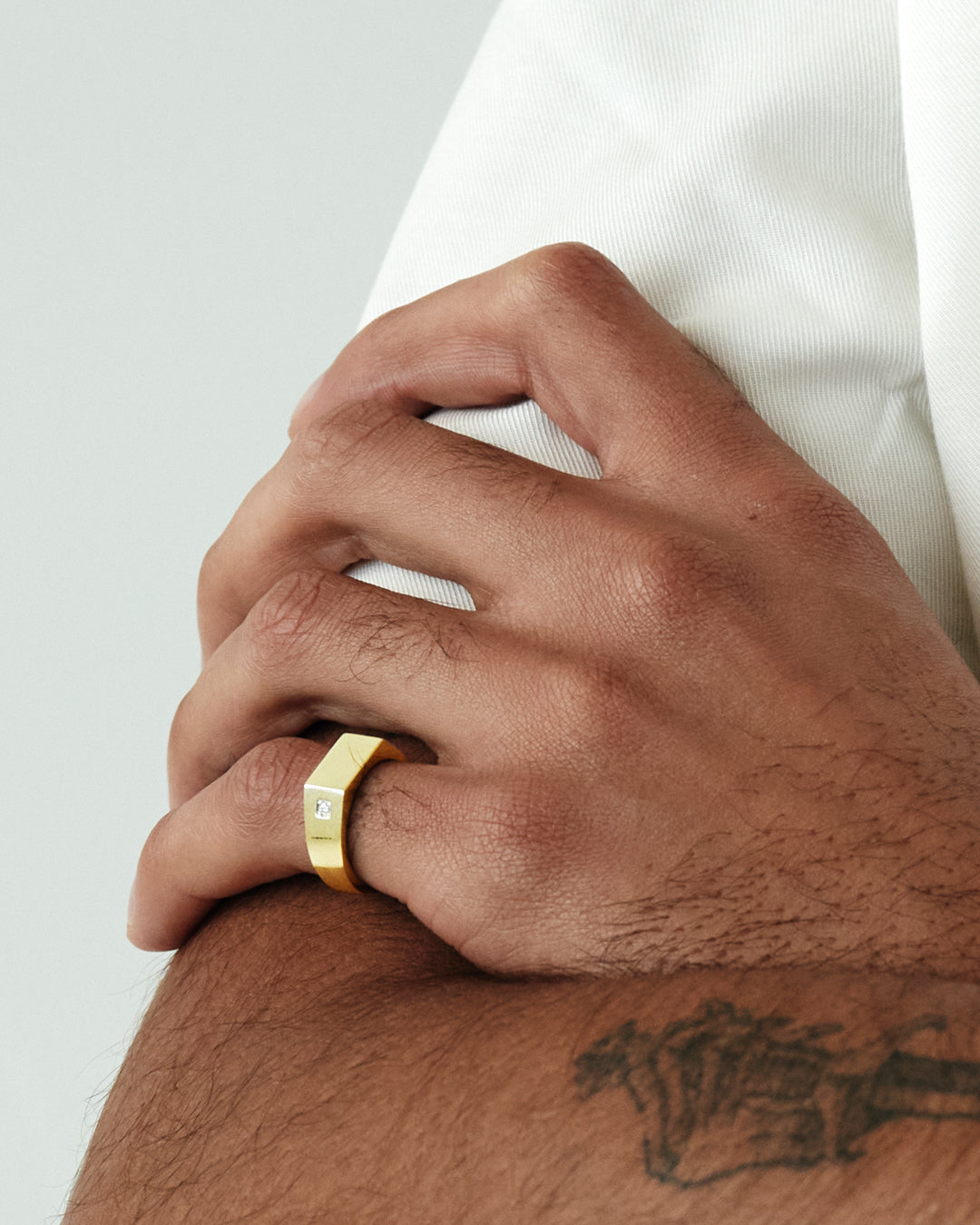


Materials
Good jewellery starts with good material. That's not a philosophy — it's just physics.
Every piece we make is solid all the way through. Not plated. Not filled. The same metal on the surface as underneath — which means it wears honestly, ages well, and lasts long enough to become someone else's problem. In the best possible way.
Here's what we work with, why we chose it, and what you should know before you decide.
Sterling Silver 925
The everyday piece. The one you forget you're wearing.
Sterling Silver 925 is 92.5% pure silver, alloyed with 7.5% copper to give it the hardness that pure silver doesn't have. Pure silver is too soft to hold a shape worth keeping. 925 is the number that means it's been done properly.
The 925 hallmark isn't marketing. It's a composition standard — and it's the one we work to because it's the one that performs.
What it looks like
Cool-toned, bright, and honest. Silver doesn't try to be anything it isn't. It sits well on all skin tones and pairs with almost everything — equally at home worn alone as it is stacked with four others.
Over time, silver develops a patina. A subtle darkening in the recesses, a lived-in warmth on the surface. Some people polish it back to bright. Others leave it. Both are correct. The patina is not a flaw — it's proof the piece has been worn, which is the whole point.
Wearing it every day
Silver is made for daily wear. It's light, comfortable, and doesn't demand much. A soft cloth every few weeks keeps it bright. A dedicated silver polishing cloth, used properly, restores it fully in a few minutes.
Worth knowing: silver reacts with moisture, sweat, chlorine, and some skincare ingredients over time. This is chemistry, not a quality issue. Take it off before swimming. Keep it away from perfume and cleaning products. It'll reward the small effort.
The honest bit
Sterling silver is not gold. It's softer, it needs slightly more attention, and it will show the evidence of a life lived in it. That's not a weakness — that's the material being honest with you. Silver is for people who wear their jewellery, not people who save it.
This is our everyday collection. The daily companion. The stacker. The piece you reach for every morning without thinking about it.
At a glance: 92.5% pure silver · 7.5% copper alloy for hardness · Cool-toned, bright finish · Develops a natural patina with wear · Occasional polishing maintains brightness · Remove before swimming and heavy chemical exposure
Solid 10K Gold
Available in Yellow Gold and White Gold
Real gold. Harder than the alternatives. Built for the way we like to live.
10K gold is 41.7% pure gold — 10 parts gold out of 24. The remaining 13.4 parts are alloy metals, which is what makes it the hardest gold we offer. More alloy means more resistance to scratching and surface wear. For a ring that's going to be on your hand every day, that's a meaningful property.
Solid means solid. The ring is the same material from the surface to the centre. When you wear through the surface of a solid gold ring over decades, you are still wearing gold. That is not true of plated or filled pieces, and it is worth understanding the difference before you buy.
What it looks like
Yellow Gold 10K reads as warm gold — a touch more restrained in colour than 14K or 18K, which suits some people's aesthetic precisely. It's not a compromise. It's a different choice.
White Gold 10K is gold alloyed with white metals — typically palladium or silver — and finished with rhodium plating to achieve a bright, cool surface. The rhodium will wear gradually with heavy daily use and may need refreshing every year or two. Any jeweller can do it. It's quick, and it's not expensive.
Wearing it every day
If you work with your hands, exercise in your ring, or simply have no interest in thinking about your jewellery, 10K is worth serious consideration. It is the most scratch-resistant gold alloy we work with. It can take more without showing it.
The honest bit
10K is not a lesser gold. It is a harder gold — which is a genuine advantage for certain wearers and certain uses. The colour is slightly less saturated than higher karats. That's the trade-off. Whether it's the right trade-off depends entirely on how you wear things.
At a glance: 41.7% pure gold · Hardest, most scratch-resistant gold alloy · Available in Yellow or White Gold · White Gold finished with rhodium plating · Best suited to active, hands-on daily wear
Solid 14K Gold
Available in Yellow Gold and White Gold
The benchmark. The alloy that most of the industry settled on, for good reason.
14K gold is 58.3% pure gold. It's the standard for everyday fine jewellery across most markets — not by convention, but because it sits at the right intersection of purity, colour depth, and durability. Enough gold for the colour to be rich and genuine. Enough alloy for the ring to hold its shape over decades of daily wear.
If you've worn fine jewellery before, it was probably 14K.
What it looks like
Yellow Gold 14K has a warm, deep tone that reads unmistakably as gold. More saturated than 10K, more wearable than 18K's full intensity. It photographs well, it works in natural light, and it holds up across different skin tones and aesthetics without asking much of the wearer.
White Gold 14K is cool-toned, clean, and sits beautifully alongside stones or as a simple band. The rhodium finish gives it a surface brightness that complements diamonds and coloured gems without competing. Like all white gold, the plating will wear over time and can be refreshed easily.
Wearing it every day
14K holds up to daily wear better than 18K and tarnishes less than silver. It resists scratching well, maintains its form reliably, and ages with dignity over years of consistent use. For a ring that's going to be on your hand every single day, this is the alloy most jewellers would recommend — and the reason why is straightforward: it performs.
The milestone conversation
Gold has moved in price. That's a fact, and it changes what a gold ring represents. At Westhill, our gold pieces sit in milestone territory — bought to mark something real. A birthday that matters. A wedding. An anniversary. A personal chapter worth commemorating in something that will outlast the occasion. 14K gold is solid enough, beautiful enough, and enduring enough to carry that weight.
At a glance: 58.3% pure gold · Industry benchmark for everyday fine jewellery · Strong balance of durability and colour depth · Available in Yellow or White Gold · The most recommended choice for daily-wear rings
Solid 18K Gold
Available in Yellow Gold and White Gold
Three quarters gold. Richer in colour, softer in feel, higher in purity. The choice for those who want the most gold in their ring.
18K gold is 75% pure gold — 18 parts out of 24. It's the alloy preferred by most of the world's serious jewellery workshops, because at 75% purity, the gold itself dominates. The colour is deeper. The material is warmer to the touch. And for people who have ever experienced sensitivity to lower-karat golds, the reduced alloy content often makes a measurable difference.
What it looks like
Yellow Gold 18K is gold at full depth. The colour is saturated, warm, and unmistakable — this is the yellow that gold is supposed to be. Under natural light, it has a richness that 10K and 14K don't quite reach. If you've ever seen a piece of jewellery and thought 'that's what gold should look like', it was probably 18K.
White Gold 18K has a natural warmth beneath the rhodium plating — a result of that high gold content — which gives it a particular depth. The surface reads cool and bright. The underlying tone is warm. The combination works well, especially set with stones.
Wearing it every day
18K is softer than 10K or 14K. That's the physics of higher gold content — gold is a relatively soft metal, and the more of it you have, the more the alloy takes on that property. In practice, this means 18K will develop surface marks more readily than lower karats. Over time, this creates a patina — a slight shift in texture and depth that many people come to value as the natural biography of a ring they've actually worn.
If you prefer the original finish, a polish restores it. If you grow to love the patina, leave it. There's no wrong answer.
The honest bit
18K costs more to make and more to buy. You are paying for a higher proportion of a precious material — not for a marketing tier. The colour is richer. The material is slightly more delicate. The purity is higher. For a milestone piece — a wedding band, a significant ring bought to mark something that deserves permanence — those are exactly the right trade-offs.
At a glance: 75% pure gold · Richest gold colour of any alloy we offer · Slightly softer — will develop a natural patina with wear · Available in Yellow or White Gold · Best choice for maximum purity and those with sensitivity to lower-karat alloys
Platinum
The rarest metal we work with. About 30 times rarer than gold. It shows.
Platinum is 95% pure platinum — an element so dense that a ring made from it has a weight and presence that no gold alloy replicates. It doesn't need to be alloyed to achieve hardness. It doesn't need to be plated to achieve its colour. It simply is what it is, all the way through, and what it is outlasts everything else we offer.
What it looks like
Naturally white. Not rhodium-plated white. Not silver-adjacent white. The colour is inherent to the material — a cool, silvery-grey that will not change over the life of the ring. Where white gold achieves its brightness through plating, platinum's tone is permanent. It will never yellow, never need re-plating, and never require intervention to stay the colour it was on the day it was made.
On the finger, platinum has a presence. It's the densest metal we work with — noticeably heavier than gold at the same gauge. People either notice this immediately and love it, or they grow into it and can't imagine anything lighter.
Wearing it every day
Platinum doesn't corrode. Doesn't tarnish. Doesn't react to chlorine, sweat, or the general accumulation of daily life the way other metals can. In terms of low-maintenance daily wearability, nothing we offer comes close.
One property worth understanding: when platinum scratches, the metal displaces rather than being lost. Gold loses tiny amounts of material with surface scratches. Platinum just moves — which means the mass of the ring is preserved over decades of wear. Over time, this displacement creates a patina: a matte, softly textured surface that many platinum wearers come to value deeply as the mark of a ring genuinely and consistently worn. If you want the original high-polish finish back, a jeweller can restore it. But most people don't ask.
For rings set with stones: platinum holds them with more grip and more permanence than gold alloys over long periods. The density of the material and the way it behaves under the setting tools makes it the safest long-term home for a stone you don't want to lose.
For anyone with sensitive skin: platinum is completely hypoallergenic. There is no more biocompatible option in fine jewellery.
The honest bit
Platinum costs more. Not because of a pricing tier — because it's rarer, denser, and more demanding to work with. Our workshop uses specialised tools and techniques for platinum that aren't required for gold. That cost is real, and it's reflected in the price.
What you get in return is a ring that requires almost no maintenance, ages honestly, and will outlast any gold alternative by a significant margin. For a wedding band or a ring bought to last a lifetime, that's a reasonable exchange.
At a glance: 95% pure platinum · Naturally white — colour is permanent, no re-plating ever needed · Denser and heavier than gold · Completely hypoallergenic · Metal displaces rather than wears away — mass is preserved · Maximum long-term security for stone settings
At a glance
|
Material |
Purity |
Hardness |
Maintenance |
Best suited to |
|
Sterling Silver 925 |
92.5% silver |
Good |
Occasional polishing |
Everyday wear, stacking, daily companions |
|
Solid 10K Gold |
41.7% gold |
Excellent |
Minimal |
Active wear, hands-on daily use |
|
Solid 14K Gold |
58.3% gold |
Very good |
Minimal |
The everyday gold standard, milestone pieces |
|
Solid 18K Gold |
75% gold |
Good |
Occasional polish |
Maximum gold purity, richest colour, heirloom rings |
|
Platinum |
95% platinum |
Outstanding |
Minimal |
Lifetime investment, stone-set rings, sensitive skin |
Not sure yet?
That's a reasonable place to be. Material choice depends on how you live, what you're buying for, and what you want the ring to mean — and those aren't always obvious until you talk them through.
Get in touch at hello@westhill-store.com. No scripts, no pressure — just a conversation with the people who make the pieces.
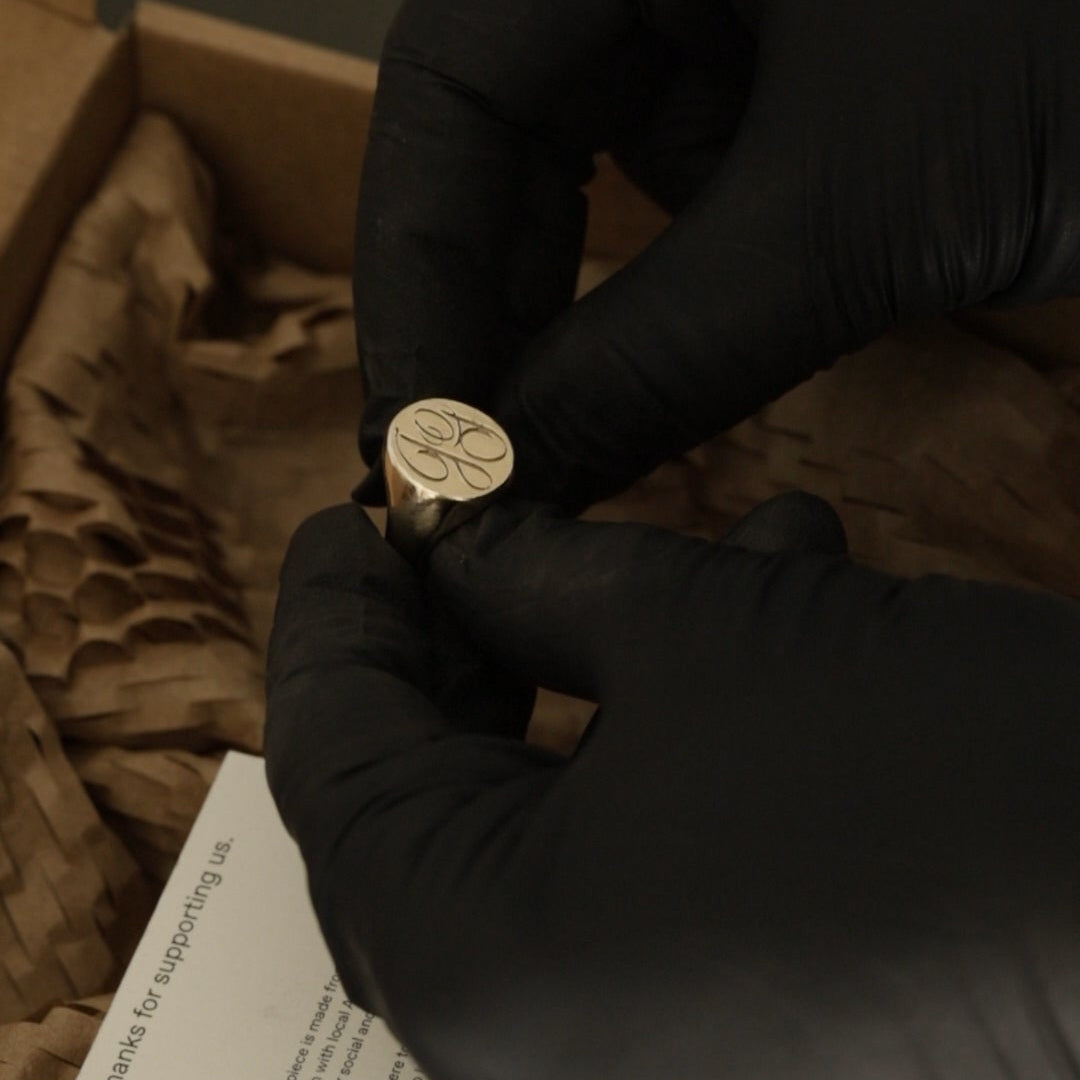
Good jewellery starts with good material choices.
Every piece we make is solid all the way through. Not plated. Not filled. The same metal on the surface as underneath - which means it wears honestly, ages well, and lasts long enough to become someone else's problem. In the best possible way.
Here's what we work with, why we chose it, and what you should know before you decide.
Material Choices
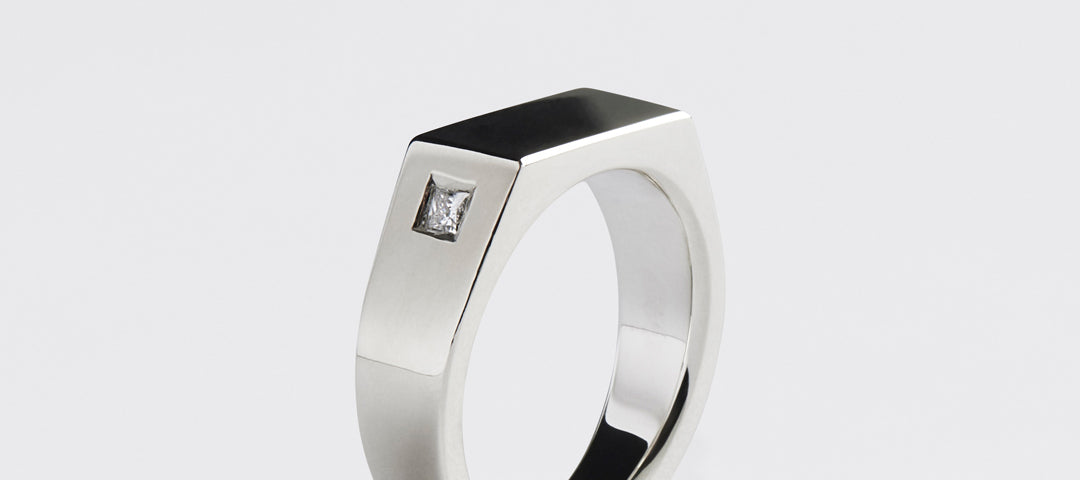
Silver
The everyday piece. The one you forget you're wearing.
Silver 925 is 92.5% pure silver, alloyed with 7.5% copper to give it the hardness that pure silver doesn't have. Pure silver is too soft to hold a shape worth keeping. 925 is the number that means it's been done properly.
The 925 hallmark isn't marketing. It's a composition standard - and it's the one we work to because it's the one that performs.
What it looks like
Cool-toned, bright, and honest. Silver doesn't try to be anything it isn't. It sits well on all skin tones and pairs with almost everything - equally at home worn alone as it is stacked with four others.
Over time, silver develops a patina. A subtle darkening in the recesses, a lived-in warmth on the surface. Some people polish it back to bright. Others leave it. Both are correct. The patina is not a flaw - it's proof the piece has been worn, which is the whole point.
Wearing it every day
Silver is made for daily wear. It's light, comfortable, and doesn't demand much. A soft cloth every few weeks keeps it bright. A dedicated silver polishing cloth, used properly, restores it fully in a few minutes.
Worth knowing: silver reacts with moisture, sweat, chlorine, and some skincare ingredients over time. This is chemistry, not a quality issue. Take it off before swimming. Keep it away from perfume and cleaning products. It'll reward the small effort.
The honest bit
Sterling silver is not gold. It's softer, it needs slightly more attention, and it will show the evidence of a life lived in it. That's not a weakness - that's the material being honest with you. Silver is for people who wear their jewellery, not people who save it.
This is our everyday collection. The daily companion. The stacker. The piece you reach for every morning without thinking about it.
At a glance: 92.5% pure silver · 7.5% copper alloy for hardness · Cool-toned, bright finish · Develops a natural patina with wear · Occasional polishing maintains brightness · Remove before swimming and heavy chemical exposure
Shop Silver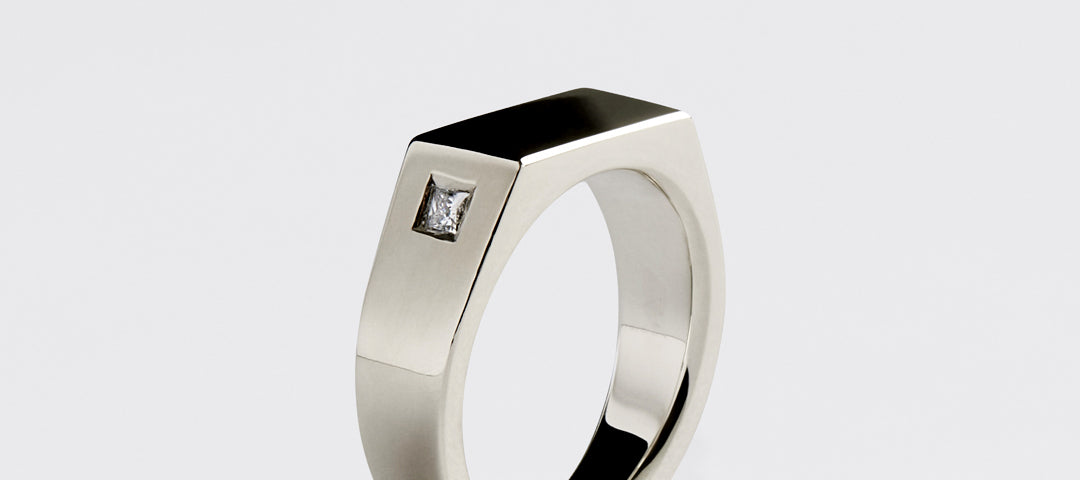
10K White Gold
Real gold. Harder than the alternatives. Built for the way we like to live.
10K gold is 41.7% pure gold - 10 parts gold out of 24. The remaining 13.4 parts are alloy metals, which is what makes it the hardest gold we offer. More alloy means more resistance to scratching and surface wear. For a ring that's going to be on your hand every day, that's a meaningful property.
Solid means solid. The ring is the same material from the surface to the centre. When you wear through the surface of a solid gold ring over decades, you are still wearing gold. That is not true of plated or filled pieces, and it is worth understanding the difference before you buy.
What it looks like
10K White Gold is gold alloyed with white metals - palladium and silver - and finished with rhodium plating to achieve a bright, cool surface. The rhodium will wear gradually with heavy daily use and may need refreshing every year or two. Any jeweller can do it. It's quick, and it's not expensive.
Wearing it every day
If you work with your hands, exercise in your ring, or simply have no interest in thinking about your jewellery, 10K is worth serious consideration. It is the most scratch-resistant gold alloy we work with. It can take more without showing it.
The honest bit
It is a harder gold - which is a genuine advantage for certain wearers and certain uses. The colour is slightly less saturated than higher karats. That's the trade-off. Whether it's the right trade-off depends entirely on how you wear things.
At a glance: 41.7% pure gold. Hardest, most scratch-resistant gold alloy. Best suited to active, hands-on daily wear
Shop 10K White Gold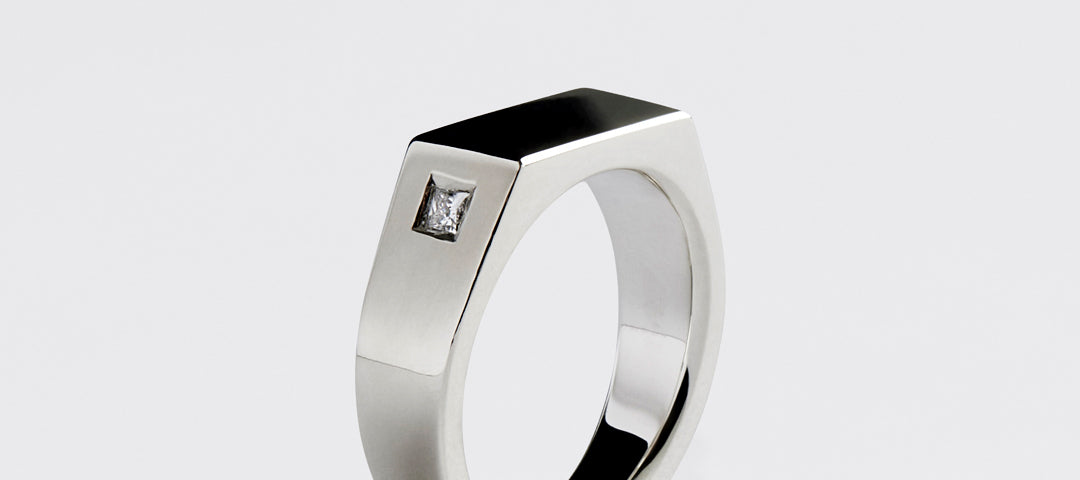
Platinum
The rarest metal we work with. About 30 times rarer than gold. It shows.
Platinum is 95% pure platinum - an element so dense that a ring made from it has a weight and presence that no gold alloy replicates. It doesn't need to be alloyed to achieve hardness. It doesn't need to be plated to achieve its colour. It simply is what it is, all the way through, and what it is outlasts everything else we offer.
What it looks like
Naturally white. Not rhodium-plated white. Not silver-adjacent white. The colour is inherent to the material - a cool, silvery-grey that will not change over the life of the ring. Where white gold achieves its brightness through plating, platinum's tone is permanent. It will never yellow, never need re-plating, and never require intervention to stay the colour it was on the day it was made.
On the finger, platinum has a presence. It's the densest metal we work with - noticeably heavier than gold at the same gauge. People either notice this immediately and love it, or they grow into it and can't imagine anything lighter.
Wearing it every day
Platinum doesn't corrode. Doesn't tarnish. Doesn't react to chlorine, sweat, or the general accumulation of daily life the way other metals can. In terms of low-maintenance daily wearability, nothing we offer comes close.
One property worth understanding: when platinum scratches, the metal displaces rather than being lost. Gold loses tiny amounts of material with surface scratches. Platinum just moves - which means the mass of the ring is preserved over decades of wear. Over time, this displacement creates a patina: a matte, softly textured surface that many platinum wearers come to value deeply as the mark of a ring genuinely and consistently worn. If you want the original high-polish finish back, a jeweller can restore it. But most people don't ask.
For rings set with stones: platinum holds them with more grip and more permanence than gold alloys over long periods. The density of the material and the way it behaves under the setting tools makes it the safest long-term home for a stone you don't want to lose.
For anyone with sensitive skin: platinum is completely hypoallergenic. There is no more biocompatible option in fine jewellery.
The honest bit
Platinum costs more. Not because of a pricing tier - because it's rarer, denser, and more demanding to work with. Our workshop uses specialised tools and techniques for platinum that aren't required for gold. That cost is real, and it's reflected in the price.
What you get in return is a ring that requires almost no maintenance, ages honestly, and will outlast any gold alternative by a significant margin. For a wedding band or a ring bought to last a lifetime, that's a reasonable exchange.
At a glance: 95% pure platinum · Naturally white - colour is permanent, no re-plating ever needed · Denser and heavier than gold · Completely hypoallergenic · Metal displaces rather than wears away - mass is preserved · Maximum long-term security for stone settings
Shop PlatinumYellow Gold Choices
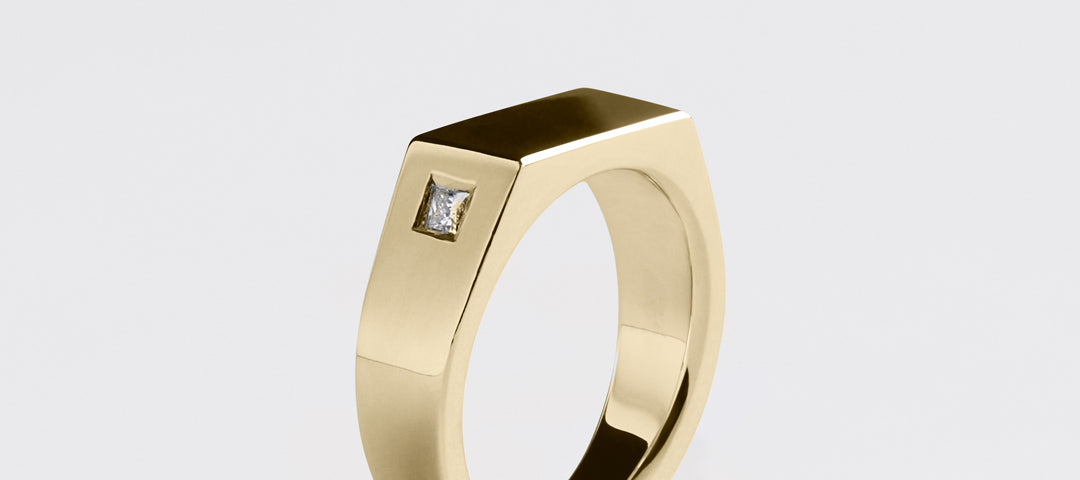
10K Yellow Gold
Real gold. Harder than the alternatives. Built for the way we like to live.
10K gold is 41.7% pure gold - 10 parts gold out of 24. The remaining 13.4 parts are alloy metals, which is what makes it the hardest gold we offer. More alloy means more resistance to scratching and surface wear. For a ring that's going to be on your hand every day, that's a meaningful property.
Solid means solid. The ring is the same material from the surface to the centre. When you wear through the surface of a solid gold ring over decades, you are still wearing gold. That is not true of plated or filled pieces, and it is worth understanding the difference before you buy.
What it looks like
Yellow Gold 10K reads as warm gold - a touch more restrained in colour than 14K or 18K, which suits some people's aesthetic precisely. It's not a compromise. It's a different choice.
White Gold 10K is gold alloyed with white metals - palladium and silver - and finished with rhodium plating to achieve a bright, cool surface. The rhodium will wear gradually with heavy daily use and may need refreshing every year or two. Any jeweller can do it. It's quick, and it's not expensive.
Wearing it every day
If you work with your hands, exercise in your ring, or simply have no interest in thinking about your jewellery, 10K is worth serious consideration. It is the most scratch-resistant gold alloy we work with. It can take more without showing it.
The honest bit
10K is not a lesser gold. It is a harder gold - which is a genuine advantage for certain wearers and certain uses. The colour is slightly less saturated than higher karats. That's the trade-off. Whether it's the right trade-off depends entirely on how you wear things.
At a glance: 41.7% pure gold · Hardest, most scratch-resistant gold alloy · Best suited to active, hands-on daily wear
Shop 10K Yellow Gold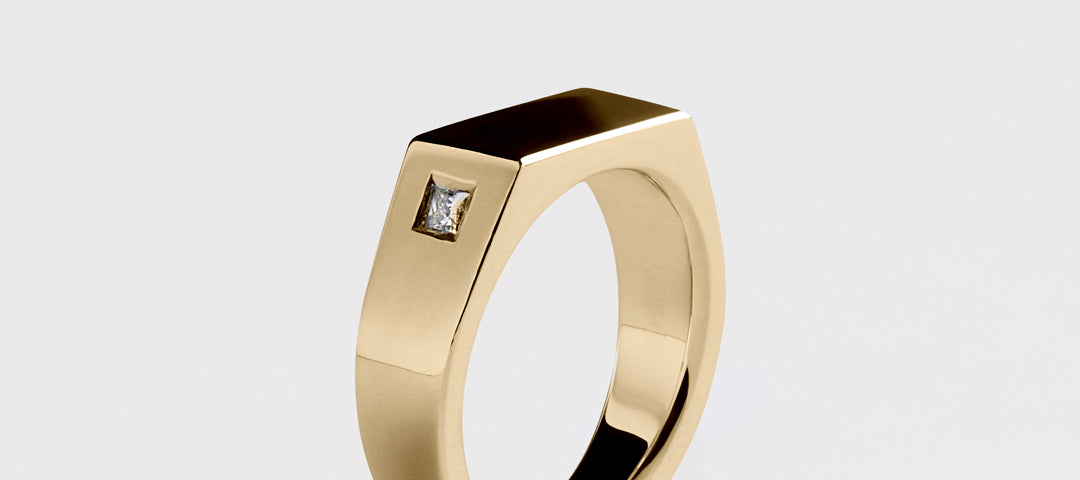
14K Yellow Gold
An upgrade for special occasions and milestones. Similarly durable, but with more gold.
14K gold is 58.3% pure gold. Often used for fine jewellery - not by convention, but because it sits at the right intersection of purity, colour depth, and durability. Enough gold for the colour to be rich and genuine. Enough alloy for the ring to hold its shape over decades of daily wear.
What it looks like
Yellow Gold 14K has a warm, deep tone. More saturated than 10K, more wearable than 18K's full intensity. It photographs well, it works in natural light, and it holds up across different skin tones and aesthetics without asking much of the wearer.
Wearing it every day
14K holds up to daily wear better than 18K and tarnishes less than silver. It resists scratching well, maintains its form reliably, and ages with dignity over years of consistent use. For a ring that's going to be on your hand every single day, this is the alloy most jewellers would recommend - and the reason why is straightforward: it performs.
The milestone conversation
Gold has moved in price. That's a fact, and it changes what a gold ring represents. At Westhill, our gold pieces sit in milestone territory - bought to mark something real. A birthday that matters. A wedding. An anniversary. A personal chapter worth commemorating in something that will outlast the occasion. 14K gold is solid enough, beautiful enough, and enduring enough to carry that weight.
At a glance: 58.3% pure gold · Industry benchmark for everyday fine jewellery · Strong balance of durability and colour depth · The most recommended choice for wedding rings.
Shop 14K Yellow Gold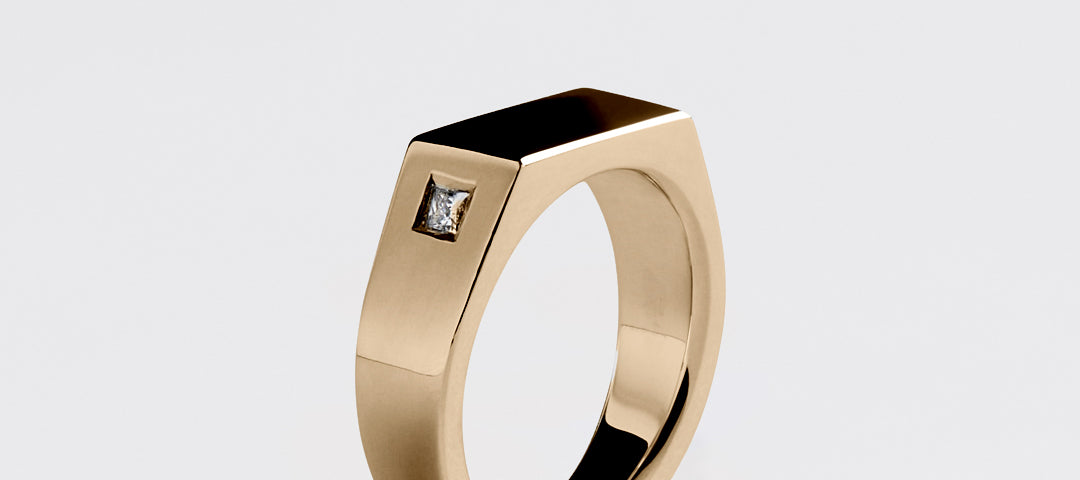
18K Yellow Gold
Three quarters gold. Richer in colour, softer in feel, higher in purity. The choice for those who want the most gold in their ring.
18K gold is 75% pure gold - 18 parts out of 24. At this purity, the gold itself dominates. The colour is deeper. The material is warmer to the touch.
What it looks like
Yellow Gold 18K is gold at full depth. The colour is saturated, warm, and unmistakable. Under natural light, it has a richness that 10K and 14K don't quite reach.
Wearing it every day
18K is softer than 10K or 14K. That's the physics of higher gold content - gold is a relatively soft metal, and the more of it you have, the more the alloy takes on that property. In practice, this means 18K will develop surface marks more readily than lower karats. Over time, this creates a patina - a slight shift in texture and depth that many people come to value as the natural biography of a ring they've actually worn.
If you prefer the original finish, a polish restores it. If you grow to love the patina, leave it. There's no wrong answer.
The honest bit
18K costs more to make and more to buy. You are paying for a higher proportion of a precious material - not for a marketing tier. The colour is richer. The material is slightly more delicate. The purity is higher. For a milestone piece - a wedding band, a significant ring bought to mark something that deserves permanence - those are exactly the right trade-offs.
At a glance: 75% pure gold · Richest gold colour of any alloy we offer · Slightly softer - will develop a natural patina with wear · Best choice for maximum purity
Shop 18K Yellow Gold| Material | Purity | Hardness | Maintenance | Best suited to |
|---|---|---|---|---|
| Sterling Silver 925 | 92.5% silver | Good | Occasional polishing | Everyday wear, stacking, daily companions |
| Solid 10K Gold | 41.7% gold | Excellent | Minimal | Active wear, hands-on daily use |
| Solid 14K Gold | 58.3% gold | Very good | Minimal | An upgrade for milestone pieces |
| Solid 18K Gold | 75% gold | Good | Occasional polish | Maximum gold purity, richest colour, heirloom rings |
| Platinum | 95% platinum | Outstanding | Minimal | Lifetime investment, stone-set rings, sensitive skin |
Not sure yet?
That's a reasonable place to be. Material choice depends on how you live, what you're buying for, and what you want the ring to mean - and those aren't always obvious until you talk them through.
Get in touch at hello@westhill-store.com. No scripts, no pressure - just a conversation with the people who make the pieces.
What's the difference between 10K, 14K and 18K gold?
They're the same metal in different proportions. 10K is 41.7% pure gold, 14K is 58.3%, and 18K is 75%. Less gold (more alloy) means a harder, more scratch-resistant ring; more gold means richer colour and higher purity. 10K suits active daily wear, 14K is the milestone upgrade, and 18K is the choice for maximum purity and depth of colour.
Is Westhill's gold solid or plated?
Solid, all the way through. Every piece is the same metal on the surface as underneath - nothing plated, nothing filled - so when the surface wears over decades, you're still wearing gold.
Does sterling silver tarnish?
It develops a natural patina over time, a subtle darkening that many people consider proof the piece has been worn rather than a flaw. A soft cloth, or a dedicated silver polishing cloth, restores brightness in a few minutes.
Is platinum better than gold?
It depends what you value. Platinum is naturally white rather than rhodium-plated, doesn't tarnish, is hypoallergenic, and holds stones with more long-term security - but it costs more and sits heavier on the hand. Gold offers more colour choice at a slightly lower price point for the same design.
Which metal is best for everyday wear?
10K gold is the most scratch-resistant option we offer, followed by 14K. Platinum is the lowest-maintenance overall since it doesn't tarnish or corrode. Sterling silver is light and comfortable but needs a little more care.